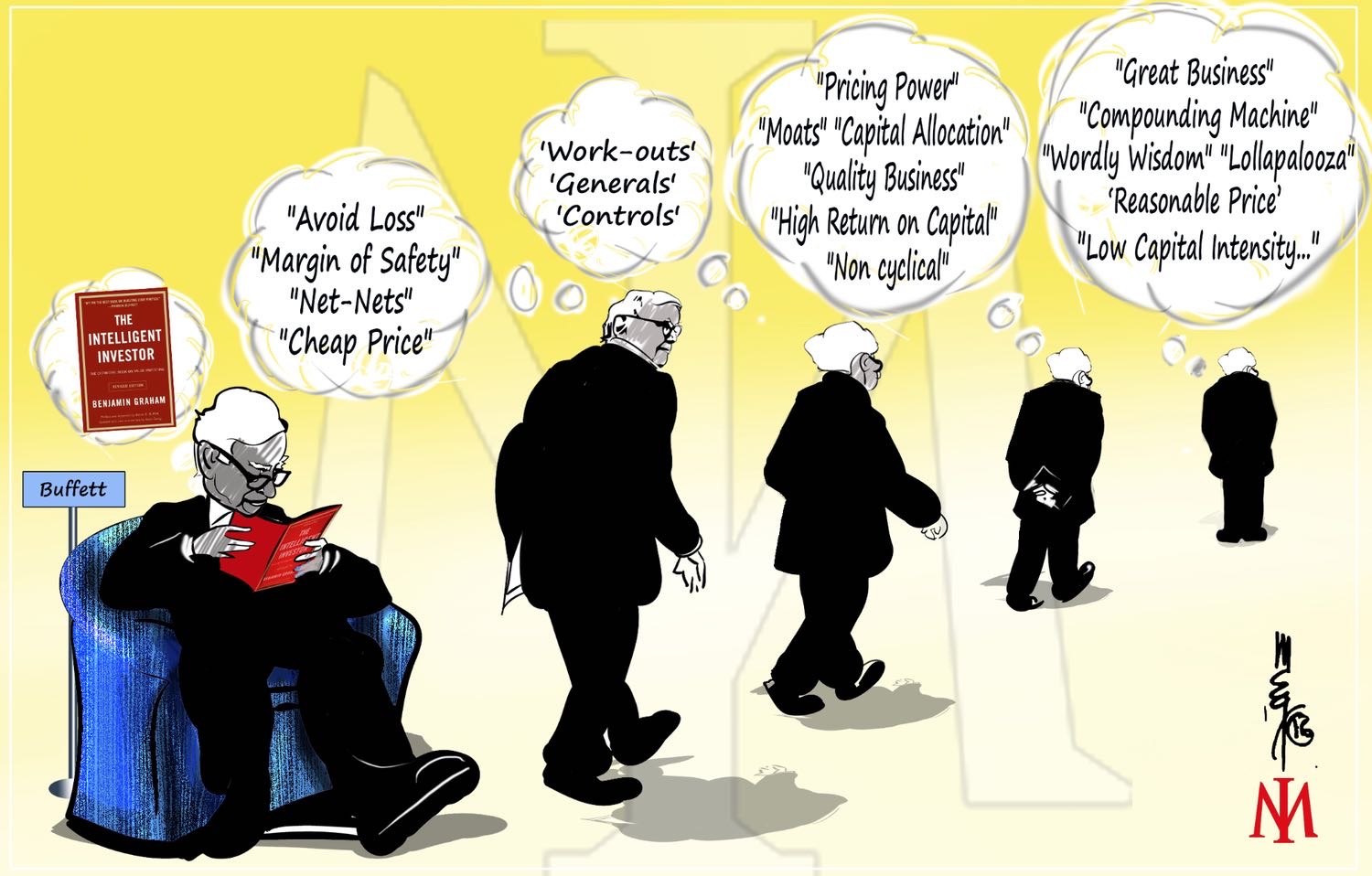
Transisi dalam Memahami Value
Pada postingan ini saya akan share pendapat para investor hebat dari beberapa negara mengenai metode investasi saham yang lebih berfokus pada kualitas bisnis dan manajemen suatu perusahaan berikut kesuksesannya.
Tapi sebelumnya saya share dulu pendapat dari Benjamin Graham yang merupakan legenda investasi dan father of value investing: “The risk of paying too high a price for good-quality stocks – while a real one – is not the chief hazard confronting the average buyer of securities. Observation over many years has taught us that the chief losses to investors come from the purchase of low-quality securities at times of favorable business conditions”.
Menurut beliau, risiko terbesar yang akan dialami oleh investor bukan berasal dari pembelian pada harga yang terlalu tinggi, tetapi berdasarkan observasi selama bertahun-tahun telah mengajarkan kita bahwa kerugian terbesar yang dialami investor berasal dari pembelian efek yang berkualitas rendah pada saat kondisi bisnis sedang bagus2nya. Kalimat tersebut dapat anda temukan dalam buku The Intelligent Investor, bab 20.
Seorang legend investor lainnya yang merupakan salah satu investor yang dikagumi oleh Warren Buffett adalah seorang Philip Fisher yang menulis buku Common Stock Uncommon Profit. Dalam bukunya, Fisher mengatakan “Even in those earlier times, finding the really outstanding companies and staying with them through all the fluctuations of a gyrating market proved far more profitable to far more people than did the more colorful practice of trying to buy them cheap and sell them dear”.
Philip Fisher menekankan bahwa metode buy and hold bisnis yang luar biasa itu lebih nyaman untuk dilakukan dan lebih menawarkan imbal hasil yang lebih memuaskan, meskipun pasar selalu berfluktuasi.
Berikut saya uraikan pendapat-pendapat lainnya:
"Buying Berkshire Hathaway itself was a mistake because Berkshire was a lousy textile business and I bought it very cheap. I'd been taught by Ben Graham to buy things on a quantitative basis and look around for things that are cheap. I was taught that in 1949-50 and it made a big impression on me. So I went around looking for what I call used cigar butts of stocks. You find on the street this terrible looking soggy cigar butt with one puff left in it, disgusting but it's free, it's cheap. Then you look for the next one. That's what I did for years. It's a mistake. Although you make money doing it you can't make it with big money. It's so much easier buying wonderful businesses. Now I'd rather buy a wonderful business at a fair price that a fair business at a wonderful price. Berkshire was selling below it's working capital per share, you got plants for nothing, you got machinery for nothing, you got the inventory and receivables at a discount. It was cheap, so I bought it and twenty years later I was still running a lousy business and that money did not compound. Time is the friend of the wonderful business, you keep compounding. Time is the enemy of the lousy business. Staying with those businesses is a mistake." (Warren Buffett)
“A great company keeps working when you’re not. A great company will eventually earn more and more and more while you’re just sitting and doing nothing. And a mediocre company won’t do that. So you’re harnessing a long range force that will help you. It’s very important. These mediocre companies, they by and large are going to cause a lot of agony and very modest profits. If you do fine, you’ve got to sell it and find another one. It’s a lot of work. Whereas you just buy one great company, and if you get the right thing at the right price, you just sit there.” (Charlie Munger)
"Why would anyone want to own a mediocre company just because it's cheap, when you can own and live with great companies?" (T Rowe Price)
"I started out looking for cheap securities. Over time, I really fell in love with strong businesses. I morphed into finding strong businesses at bargain prices. I still have a streak in me that favors finding really cheap securities - I just can't help it. But over time, I've become more attracted to looking for great businesses that are inherently superior, more competitive, easier to predict, and with strong management teams." (Li Lu)
“One lesson that has been very slow for me to learn but I get more and more appreciation for is it’s far better to buy a good business at a fair price than a fair business at a good price. I started life as a bargain hunter and I'm still a bargain hunter and I've learned to appreciate that. The transition I've made is I don't want to buy pure bargains that much anymore. I'm more interested in moats that are at bargain prices, but it's probably another level of evolution to be able to buy moats which don't appear to be cheap but may in the end be wonderful. If I was talking to my younger self that's what I would tell him is to look for the great businesses. The Holy Grail from my perspective is that because there are 50,000 stocks, the market does give you every so often great moats at great prices.” (Mohnish Pabrai)
“We look for very high quality businesses, what we'd describe as simple, predictable, free-cashflow generative dominant businesses. A business Warren Buffett would describe as having a moat around it." (Bill Ackman)
"Characteristics of a good business include businesses that provide a demonstrable convenience to customers or a high value-added product or service, businesses capable of withstanding industry turmoil or a period of mismanagement, slowly evolving businesses with simple business models, businesses with recurring revenue streams and no need to continually recreate demand and/or replace customers, businesses with a minimum of uncontrollable factors affecting their results, businesses that do not have a concentrated customer base, and businesses that generate surplus cash flow after funding their growth." (Jeffrey Ubben)
“When we think about companies, the over-riding analytical consideration is the quality of the business and quality of management’s capital allocation decisions. The longer investors own shares the more their outcome is linked to these two metrics.” (Nicholas Sleep)
"With respect to quality businesses, the key aspects are unit economics, returns on capital, appropriate leverage, free-cash conversion, market share, margin resiliency, moat, long-term growth potential, and management. The motivation for focusing on these types of businesses is that they blow up less frequently, and even if they do blow up, they do so with less severity. High-quality businesses also provide natural tailwinds to returns by virtue of their economics, and their resiliency enables portfolio concentration, which is valuable because it affords the opportunity to perform deep primary research." (Adam Weiss)
"My initial emphasis was just on valuation. The cheaper, the better. There were of course other parts to the analysts, of course, but the energy went to finding discounted companies. The bigger the discount, the more interesting, and that's the work you focused on. As I evolved, I began to feel that it was even more important to focus on business quality, specifically value stability.” (C.T Fitzpatrick)
"The requirements for a great business for us have three components. The first is, we spend a lot of time trying to understand what is causing the above average return to occur. Is it getting better or worse? The second thing we look for are the people who run the business. Not only do we want to have great business managers but we want see they treat public shareholders as partners even as though don't know them. Lastly, we look to see if there is a great history of reinvestment of the free cash-flow as well as a significant opportunity to reinvest free cash-flow and earn above average rates of return. None of those things ever behave in a constant fashion. Business models get better or worse. Peoples behaviour sometimes change modestly. The ability to reinvest or the results from re-investment vary from time to time. We make a judgement about which are real keepers." (Chuck Akre)
“Quality matters, in businesses and in people. Better-quality businesses are more likely to grow and compound cash flow; low-quality businesses often erode and even superior managers, who are difficult to identify, attract, and retain, may not be enough to save them.” (Seth Klarman)
“This isn’t unique to us, but we want companies with large amounts of free cash flow, good business dynamics, a proven ability to profitably reinvest that cash flow and management properly incentivized to do the right thing for shareholders. We generally focus on businesses that are “two-cycle tested,” where they’ve been through a couple recessions and have survived intact.” (Leon Cooperman)
"I tend to avoid the shares of weaker companies, even if their shares are selling at depressed prices. I strongly prefer purchasing undervalued shares of strong and well-positioned companies." (Ed Wachenheim)
“I am very interested in super high quality companies that have demonstrated success, have demonstrated earnings and high ROC and have some durable features that can give us high conviction” (Chuck Royce)
“Good is the enemy of great. We see many companies that are just fine ... founders are good, market seems good, product seems good, customers kinda like it, and they got a little revenue and it's all fine, but those companies tend to never go anywhere. Every once in a while we'll see these companies that have some extremely strong strength, some extremely special wonderful thing going on, that by the way may have all kinds of problems and issues, but there's something at the core of what it is that's really special and magical. And those are the ones that we want to do. We're trying to stock our portfolio with just investments like that." (Marc Andreessen)
"The idea is not just to find cheap businesses, but to find good businesses! I learned that a cheap business can kill you, but a good business won't. I remember investing in a Spanish textile company that was selling below net cash. The stock was cheap, but the business was so lousy that the management team not only failed to keep it operating, but also lost all of its cash and assets. So sustainability and quality matter!" (Francisco Garcia Parames)
“Quality is the foundation of our portfolio. To us, quality is defined by one question: is time your friend? Quality is a protective moat that allows companies to grow and thrive through unpredictable economic cycles.” (Lei Zhang)
“I have a bias towards quality businesses, especially family-owned. Many of our value competitors start the process of identifying likely investments by starting with price. Looking at a screen. We don’t believe in those screens. Cheap looking stocks will end up on screens. They will be either the lousiest competitors in an industry or operating in industries which are overly competitive. What makes us want to investigate a stock idea - it’s not that it looks cheap - but if there seems to be something unique or superior about it. It may not optically look cheap.” (Charles De Vaulx)
“To me it appears that exceptional companies with durable competitive advantages are in fact cheap almost all the time. The point is such companies are rare. It is plain wrong to expect them to be valued similarly to what is the vast majority of ephemeral, low value-added businesses.” (Nick Train)
“We aim to invest in high quality businesses. This may sound blindingly obvious, but you might be surprised how many investors either don’t do this or do not have a good definition of a high quality business. In our view, a high quality business is one which can sustain a high return on operating capital employed.” (Terry Smith)
Saudara2, sudah jelas ya berdasarkan pendapat para investor bahwa investasi saham itu salah satunya kita mesti fokus hanya pada kualitas yg dimiliki perusahaan lalu membeli sahamnya di harga yang wajar dan memegangnya dalam jangka waktu yang panjang. Ini sejalan dengan apa yang telah saya lakukan selama ini dalam berinvestasi.
Sekarang saya memasuki tahun ke 6 dalam berinvestasi dan kinerja portofolio saya yang berisi saham $EKAD $SIDO $SMSM setiap tahun mengungguli kinerja pasar secara keseluruhan serta telah menghasilkan tingkat return yang sangat memuaskan dengan risiko yang rendah. dan akhir Januari kemarin anggota portofolio bertambah 1 yakni $ULTJ
Selama ini juga saya tidak banyak tingkah/hyperactive di bursa, artinya saya sangat jarang melakukan transaksi jual beli dalam waktu yang singkat, sehingga modal2 saya tidak tergerus banyak untuk saya sedekahkan ke broker.
Secara penyebutan memang metode ini disebut sebagai QUALITY INVESTING atau “Sit On Your Ass Investing”, seperti yang diterapkan pula oleh Philip Fisher, Charlie Munger, Warren Buffett, dan investor-investor hebat lainnya.
Saya dan mereka tidak sekedar mencari perusahaan yang murah atau dijual di bawah intrinsik value yang dihitung berdasarkan rumus atau formula yang ribet yang dipelajari banyak orang selama ini lalu menjualnya ketika harga sudah melampaui intrinsik value (and repeat).
Kami mengombinasikan analisis kualitatif dan kuantitatif untuk menemukan perusahaan berkualitas baik dan memiliki saham perusahaan tersebut untuk meningkatkan kekayaan kami selama perusahaan masih memenuhi syarat kualitas yang bagus. Kami membayar dengan harga yang wajar untuk mendapatkan barang yang berkualitas baik dan tahan lama. Menurut teori yang berkembang selama ini bahwa membeli saham yang agak mahal itu menimbulkan risiko dan memperkecil potensi return. Lalu bagaimana dengan kinerja portofolio Berkshire Hathaway, Fundsmith, dan Lindsell Train saat ini?
Sebagian dari investor hebat tersebut seperti Warren Buffet, Mohnish Pabrai, Li Lu, Lei Zhang, dan C.T Fitzpatrick awalnya adalah pemburu saham “murah” dengan mengesampingkan quality. Tapi, semakin kesini trend-nya sudah berubah. Para investor-investor hebat ini lebih fokus untuk memburu perusahaan dengan kualitas yang baik meskipun tidak terhitung sebagai undervalue.
Dengan demikian, apakah ini yang dinamakan “the death of value investing”? Saya rasa tidak juga. Value investing tidak akan pernah mati, tapi ia berkembang mengikuti perkembangan zaman. Metode investasi yang baik itu ya tetap value investing, dan aspek quality dan growth itu merupakan bagian dari value. Tinggal kita mau lebih fokus kemana, fokus pada quality atau pada growth atau kombinasi keduanya?
Dan sangat disayangkan kebanyakan orang yang mengaku “value investor” salah mempraktekkan value investing dengan hanya sekedar mencari saham yang undervalue denga MoS yang tinggi, tapi lupa untuk mengidentifikasi kualitas dan potensi pertumbuhan bisnis di masa yang akan datang. Sebagian besar terlalu hobi melakukan hitungan-hitungan dengan macam2 formula yang ribetnya minta ampun, sampai-sampai ada yang menghitung Value at Risk segala, dan mengambil keputusannya berdasarkan analisis kuantitatif semata. Maaf ya kawan, investasi saham nggak seanj*ng itu. Kebanyakan mereka terlalu banyak menghitung, tapi sangat sedikit yang membaca dan berfikir.
Last, mencari saham yang di bawah nilai intrinsiknya adalah hal yang penting. Namun ingatlah bahwa nilai intrinsiknya suatu perusahaan tidak hanya diukur berdasarkan tangible asset atau book value perusahaan, tapi di dalamnya ada juga elemen kualitatif seperti economic moat, franchise value, brand equity, dan great management.
*sumber gambar: https://cutt.ly/7XpyscS