

Peter Lynch, a legend in the world of investing, shares his back-testing results on perfect market timing. The results was shocking.
Let's pull up the quotes from his Worth magazine write-up in 1997:
“I’ve gone through this before, but let me give you another example based on actual stock-market performance from 1965 through 1995, a period with good years and bad. Imagine three investors, each of whom puts 1000 dollar into stocks annually over these three decades.
Investor 1, who is very unlucky, somehow manages to buy stocks on the most expensive day of each year. Investor 2, who is very lucky, buys stocks on the cheapest day of each year. Investor 3 has a system: She always buys her stocks on January 1, no matter what.
You’d think that Investor 2, having an uncanny knack for timing the market, would end up much richer than Investor 1, the unluckiest person on Wall Street, and would also outperform Investor 3.
But over 30 years, the returns are surprisingly similar. Investor 1 makes 10.6% annually; Investor 2, 11.7%; and Investor 3, 11%. Even I am amazed that perfect timing year after year is worth only 1.1% more than horrible timing year after year.”
This back-testing over three decades shows that the prize we get for perfect market timing is only 1.1% annualized.
Fast forward to today, and you might think things have changed. But a replication of this study by Running Point Capital, covering 1994 to 2020, echoes similar findings: perfect timing offers a mere 1.5% annualized advantage.
Perhaps you’re thinking, “Hey! But, 1%+ compounded over decades could make a significant difference.”
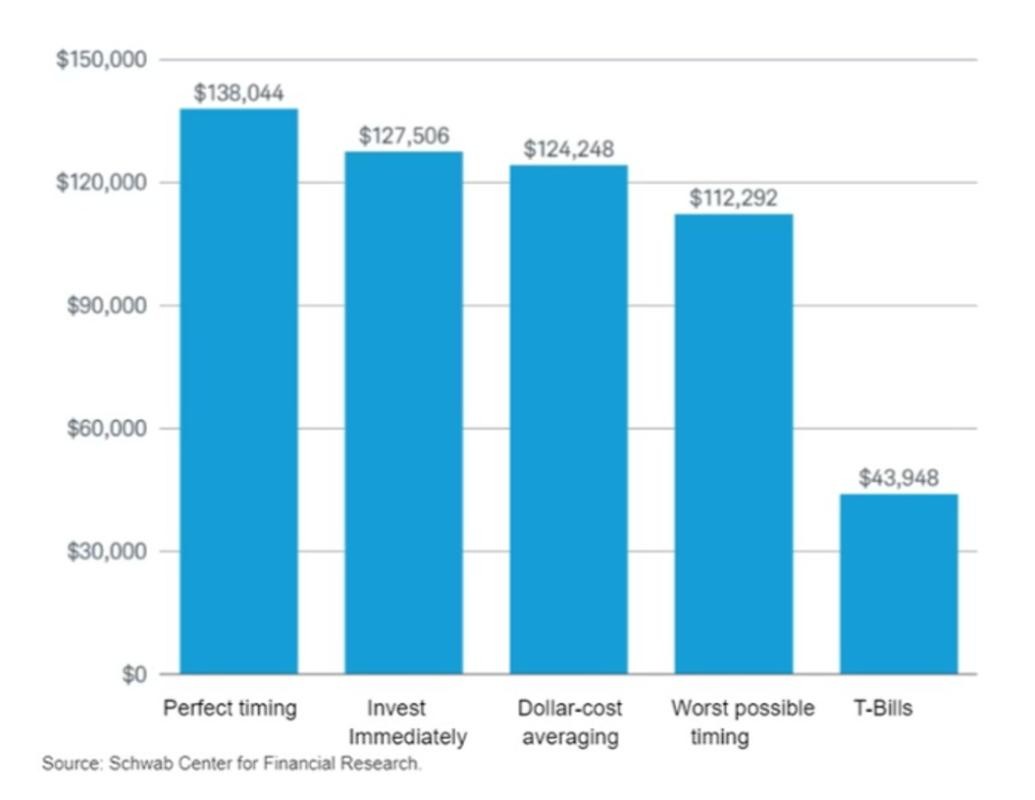
In a study done by Schwab Center for Financial Research between 2003 to 2022, the difference between “Perfect timing” and “Worst possible timing” is 25,752 dollar, or 18.7% worse off in absolute terms.
In the perfect timing scenario, the investor annually invests 2000 dollar at the market’s lowest point. In contrast, the worst timing involves investing at each peak.
But let’s be honest, is there anyone in the world who can time the market perfectly for two decades?
𝐀𝐧𝐝 𝐡𝐞𝐫𝐞’𝐬 𝐚 𝐬𝐭𝐚𝐫𝐭𝐥𝐢𝐧𝐠 𝐫𝐞𝐯𝐞𝐥𝐚𝐭𝐢𝐨𝐧: 𝐦𝐢𝐬𝐬𝐢𝐧𝐠 𝐣𝐮𝐬𝐭 𝐭𝐡𝐞 𝐭𝐨𝐩 𝟏𝟎 𝐭𝐫𝐚𝐝𝐢𝐧𝐠 𝐝𝐚𝐲𝐬 𝐢𝐧 𝐭𝐡𝐢𝐬 𝐩𝐞𝐫𝐢𝐨𝐝 𝐜𝐚𝐧 𝐬𝐥𝐚𝐬𝐡 𝐲𝐨𝐮𝐫 𝐫𝐞𝐭𝐮𝐫𝐧𝐬 𝐛𝐲 𝐦𝐨𝐫𝐞 𝐭𝐡𝐚𝐧 𝐡𝐚𝐥𝐟. 𝐓𝐡𝐞 𝐜𝐨𝐬𝐭 𝐨𝐟 𝐦𝐢𝐬𝐬𝐢𝐧𝐠 𝐨𝐮𝐭 𝐣𝐮𝐬𝐭 𝐭𝐡𝐞 𝐭𝐨𝐩 𝟏𝟎 𝐭𝐫𝐚𝐝𝐢𝐧𝐠 𝐝𝐚𝐲𝐬 𝐢𝐧 𝐭𝐰𝐨 𝐝𝐞𝐜𝐚𝐝𝐞𝐬 𝐬𝐢𝐠𝐧𝐢𝐟𝐢𝐜𝐚𝐧𝐭𝐥𝐲 𝐨𝐮𝐭𝐰𝐞𝐢𝐠𝐡𝐬 𝐭𝐡𝐞 𝐛𝐞𝐧𝐞𝐟𝐢𝐭 𝐨𝐟 𝐭𝐢𝐦𝐢𝐧𝐠 𝐭𝐡𝐞 𝐦𝐚𝐫𝐤𝐞𝐭 𝐩𝐞𝐫𝐟𝐞𝐜𝐭𝐥𝐲.
Considering the odds and the prize for timing the market being just ~1% annualized, I would say you are better off staying invested rather than trying to time the market.
In a perfect world, we would all like to buy at the bottom and sell at the top. But, as we don’t have a crystal ball, our focus should be on a repeatable process and minimizing downside risks.
The key? Resist the lure of market timing and stay invested.
$IHSG $BBRI $BMRI